How It Works Features
Resources
How Separation Works in Canada Financial Disclosure in Ontario Shared Parenting Expenses Interim & Final Agreements Records & Chronology Support Calculator Guide Calculator Log In Start Your Case
Co-Parenting · Shared Expenses

Shared expense tracking during separation.

Managing shared parenting and section 7 expenses can quickly become confusing and stressful. AgreeWell helps separated and co-parenting families organize approvals, receipts, reimbursements, and expense history in one structured place.

Section 1

What are shared and section 7 expenses?

When parents separate, certain child-related costs are often shared between them rather than absorbed by one parent alone. These are sometimes called shared parenting expenses or, when they fall under specific child support guidelines, section 7 expenses (sometimes called “special or extraordinary expenses”).

Common examples include:

How and when these are shared depends on each family’s situation, agreements, and any court orders in place. The goal of this page is operational, not legal: to show how AgreeWell helps families organize the practical side of shared expenses, regardless of how their split is structured.

Section 2

Why shared expenses become difficult

Even with the best intentions, shared expenses can quickly turn into a source of friction — not because anyone is acting in bad faith, but because the information lives in too many places at once.

Forgotten approvals

An activity gets signed up for in a hurry, and the “did we both agree?” question surfaces months later when the bill is due.

Lost receipts

Receipts arrive in email, on paper, or as photos in a phone gallery — and disappear right when they’re needed for reimbursement.

Unclear amounts

Without a clear share percentage on each expense, it’s easy to lose track of who owes what and how reimbursements were calculated.

Text and email confusion

Approvals scattered across texts, emails, and screenshots make it hard to reconstruct what was agreed without long, frustrating searches.

Inconsistent tracking

Spreadsheets that one parent maintains can feel one-sided. Without a shared source of truth, even small disagreements can escalate.

Uncertainty around percentages

Income-based splits change over time. Without a clear record per expense, it’s easy to second-guess what should have been applied.

Section 3

How AgreeWell organizes shared expenses

AgreeWell turns shared expenses into a structured, transparent workflow that both parents can see in real time — with receipts, approvals, and balances in one place.

Propose expenses with full context

Either parent can propose an expense — with category, amount, share percentage, who paid, due date, and supporting notes. Receipts can be attached up front, so the other parent reviews a complete picture.

Categories include extracurricular, medical, education, childcare, and any custom labels you set up on your case.
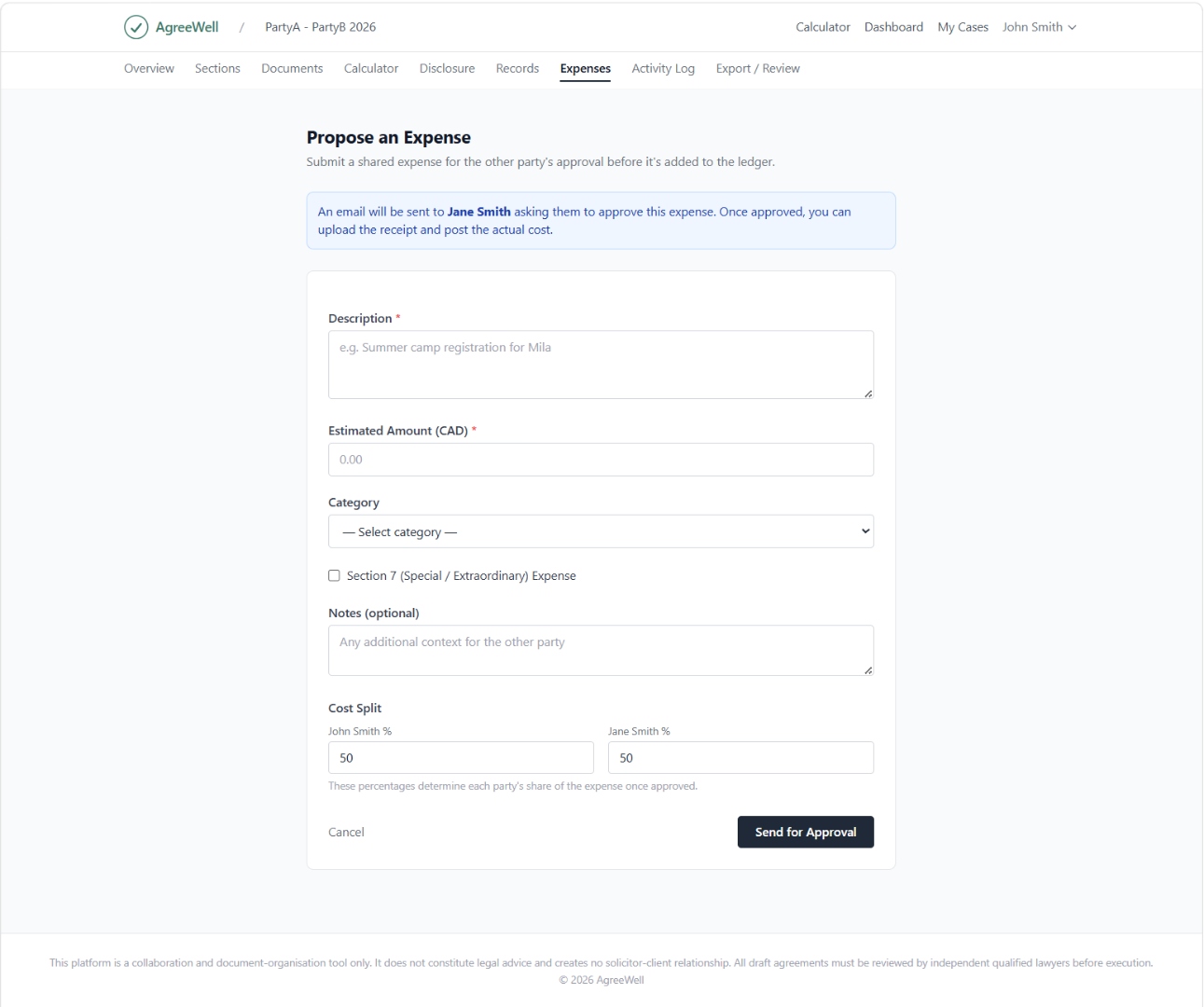
AgreeWell Propose an Expense form: description, estimated amount, category, Section 7 checkbox, notes, and a cost split between John Smith and Jane Smith
Proposing a shared expense in AgreeWell. Either parent fills in the description, estimated amount, category, optional Section 7 flag, and the cost split percentage. The other parent is notified by email and has to approve before anything is added to the shared ledger.

Structured approval & rejection

The other parent reviews the proposal and approves or rejects it — with optional comments. Approvals create a clear, timestamped record. Rejections stay attached to the expense, so the discussion never disappears into a text thread.

A short approval link can also be emailed to the other party if they’re not yet active in the platform.

Automatic splits & running balances

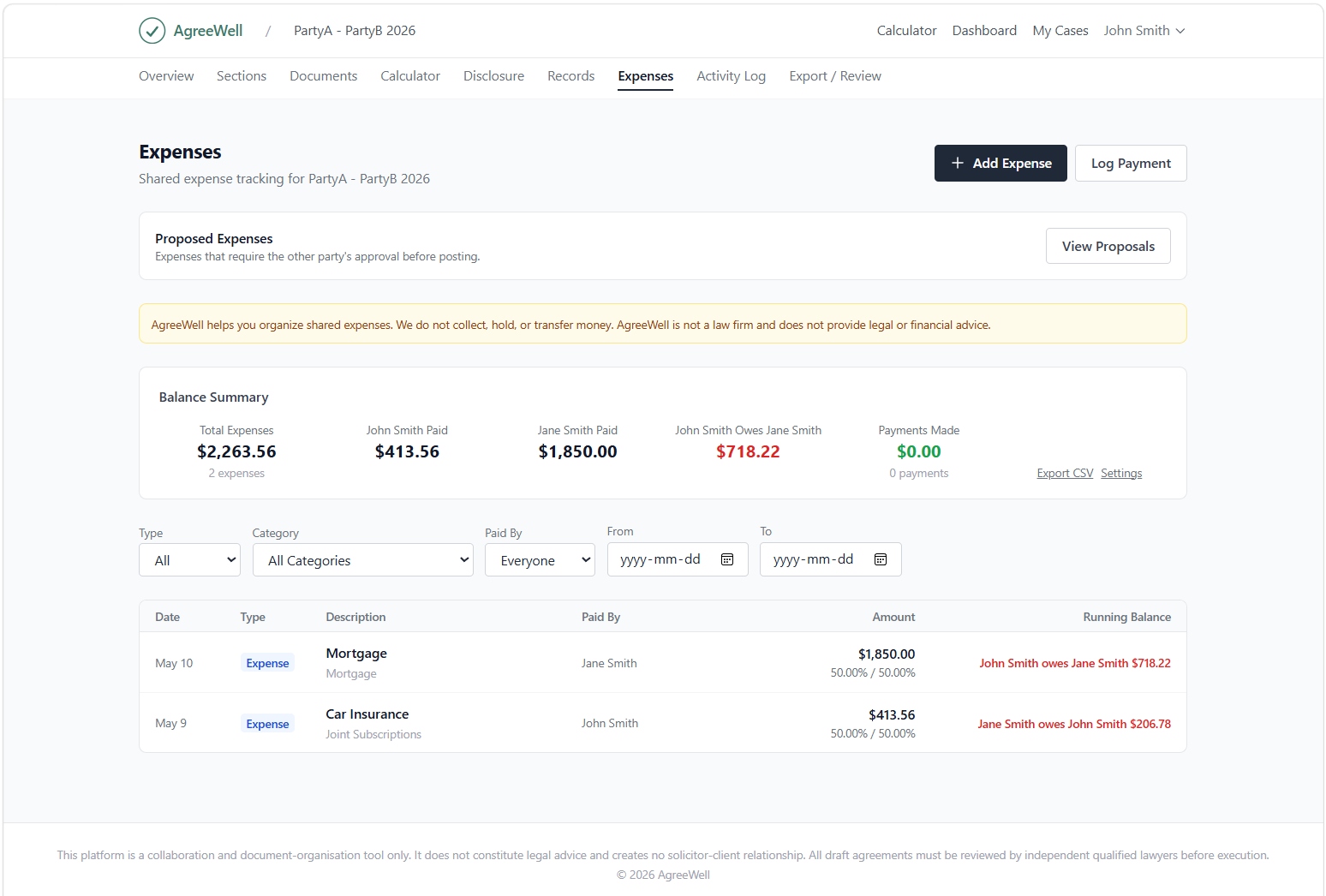
Once approved, AgreeWell calculates each parent’s share based on the percentage on that expense, then updates a running balance. You always see the same number — no spreadsheet drift, no recalculations from scratch.

Reimbursements (e-transfers, cheques, in-person payments) are recorded as offsets, so the balance reflects what’s actually been settled.
Section 4

The expense approval workflow

A simple, predictable cycle for every shared cost — designed to reduce misunderstandings and create a record both parents can rely on.

  1. 1

    Expense proposed

    One parent creates the expense with category, amount, share, and an optional receipt or note.

  2. 2

    Other party reviews

    The proposal is sent for review — in-app and (optionally) by a one-click email approval link.

  3. 3

    Approved or rejected

    The decision and any comments are saved with a timestamp. Rejections stay attached for context.

  4. 4

    Receipt uploaded

    If a receipt wasn’t attached at proposal time, it can be added once the expense is paid.

  5. 5

    Expense added to ledger

    Approved expenses are categorized and posted to the shared ledger with the agreed split.

  6. 6

    Reimbursement tracked

    When one parent pays the other back, that record offsets the running balance — so the number stays honest.

AgreeWell Expenses ledger showing balance summary, who paid what, who owes whom, filters by type and category, and a running balance against each line item
The shared expenses ledger. Once expenses are approved, both parents see the same view: total expenses, who paid what, the current net balance, and a running balance against each line. Filter by type, category, who paid, or date range — and export the whole thing to CSV at any time.
Section 5

Designed for co-parenting collaboration

AgreeWell is built around the belief that most separated parents are trying to do right by their kids — and that the right tool can take a lot of the friction out of the day-to-day.

By giving both parents the same view of proposed expenses, approvals, and balances, the platform helps families:

  • Reduce friction around small, recurring costs
  • Improve communication with structured prompts instead of long texts
  • Keep records organized in one place rather than across email and chat
  • Stay aligned on what was agreed and when
  • Build transparency around shared costs over time

AgreeWell is designed to support collaborative co-parenting by helping families organize shared responsibilities more clearly. It is not a substitute for communication or for legal advice when needed.

Section 6

For mediators and lawyers

When professionals get involved — in a mediation session, a four-way meeting, or a court-ordered review — the quality of the underlying records matters. Structured expense data saves hours of reconstruction work.

With AgreeWell, mediators and lawyers can review:

Structured expense records can help reduce confusion and improve preparedness during mediation and legal review. AgreeWell does not provide legal advice; we recommend independent professional review of any agreement covering how shared expenses are handled.

Section 7

Frequently asked questions

What are section 7 expenses?

Section 7 expenses generally refer to certain child-related costs that go beyond basic child support — such as childcare, extracurricular activities, tutoring, certain medical and dental expenses, and post-secondary education. The exact treatment depends on each family’s situation and any agreements or court orders in place. AgreeWell does not provide legal advice; we encourage independent legal review.

How are shared parenting expenses divided?

How costs are split varies between families. Many separation agreements allocate shared expenses based on each parent’s income, while others use a fixed percentage or even split. AgreeWell lets you set a share for each expense and tracks the running balance over time — so the math always reflects what was agreed.

What happens if an expense is disputed?

If a proposed expense is rejected or questioned, the discussion stays attached to the expense record — along with the receipt, category, and timestamps. This gives both parents (and any mediator or lawyer reviewing later) a clear, factual history rather than scattered text and email threads.

Can receipts be uploaded?

Yes. Each expense supports receipt uploads (PDF or image). The receipt stays attached to the expense record and is included in any exported summary.

Can reimbursement balances be tracked?

Yes. AgreeWell maintains a running balance per parent based on approved expenses and recorded reimbursements, so it’s easy to see who owes whom at any point in time.

Is AgreeWell a payment platform?

No. AgreeWell does not move money. It tracks proposed expenses, approvals, receipts, and reimbursement records so both parties have a shared, organized view of shared costs. Actual payments still happen through your normal banking method.

Does AgreeWell replace legal advice?

No. AgreeWell is not a law firm and does not provide legal advice. The platform is designed to organize the operational side of shared expenses; we recommend independent legal review of any agreement that governs how those expenses are shared.

Make shared expenses less stressful.

Shared parenting expenses don’t need to become another source of stress. AgreeWell helps families organize approvals, receipts, reimbursements, and shared costs in a more transparent and collaborative way.