How It Works Features
Resources
How Separation Works in Canada Financial Disclosure in Ontario Shared Parenting Expenses Interim & Final Agreements Records & Chronology Support Calculator Guide Calculator Log In Start Your Case
Ontario · Separation Guide

Financial disclosure during separation.

Financial disclosure is one of the most important — and often overwhelming — parts of separation. AgreeWell helps couples, mediators, and lawyers organize documents, track what's missing, and prepare structured disclosure for review.

Section 1

What is financial disclosure?

Financial disclosure is the process of sharing accurate, complete information about your income, assets, debts, and expenses with your separating spouse.

It's the foundation for every fair conversation that follows — about child support, spousal support, property division, and ultimately a separation agreement. Without it, no agreement can really be considered fair, and a court is unlikely to enforce it.

In Ontario, complete disclosure is generally required even in amicable separations. It's not adversarial — it's the basic information both people need to plan what comes next.

What disclosure typically covers:

The goal is a complete, current picture of both households' finances — accurate enough that any decisions made on top of it hold up.

Section 2

Why disclosure becomes difficult.

If disclosure feels overwhelming, that's not unusual. The process is rarely difficult because of bad intent — it's difficult because the information is scattered, the timing is hard, and the emotional weight is real.

Documents are scattered.

Statements live across email inboxes, banking apps, accountants, and physical drawers. Pulling six months of records from four institutions is a project on its own.

It's hard to know what's required.

Lists of "required documents" vary between mediators, lawyers, and forms. People often submit too little — or duplicate what's already there.

Statements arrive on different schedules.

Pay stubs come bi-weekly. Statements come monthly. Pension valuations take weeks. Disclosure becomes a moving target unless someone is tracking it.

Emotional weight makes admin feel heavier.

Going through years of joint financial history is an emotional process. Structure helps — turning a vague task into a list of clear, finishable items.

Waiting on the other party stalls things.

If one person's information is incomplete, the whole process pauses. A shared workspace makes it visible — and easier to nudge gently.

Inconsistent organization slows lawyers down.

A folder of unlabeled PDFs takes hours to sort through. Structured, categorized disclosure cuts that to minutes — which often translates to lower legal bills.

Section 3

A separation disclosure checklist.

Every situation is different, but the documents below show up in nearly every Ontario separation. Use this as a starting checklist; your mediator or lawyer may add to it.

Income

  • T4s, T4As, T5s for the last 3 years
  • Personal tax returns for the last 3 years
  • Notices of assessment for the last 3 years
  • Most recent pay stubs (last 3 months)
  • Self-employment financials, if applicable
  • Records of any government benefits or support received
Banking

  • Chequing & savings statements (6 months)
  • Joint accounts — both parties
  • Account opening / institution information
  • E-transfers showing recurring payments
  • Statements showing date of separation balance

Property

  • Most recent mortgage statement(s)
  • Property tax bills
  • Recent appraisal or valuation
  • Title deed / land transfer documents
  • Home insurance policy

Debts

  • Credit card statements (most recent)
  • Lines of credit balances
  • Personal loans & vehicle loans
  • Student loans
  • Tax debt or CRA arrears, if any

Investments & pensions

  • RRSP statements
  • TFSA statements
  • Non-registered investment accounts
  • Most recent pension statement
  • Pension valuation, if requested
  • Stock options, RSUs, business interests

Expenses

  • Children's recurring expenses (childcare, activities, medical)
  • Household utility bills
  • Insurance premiums
  • Anything currently paid jointly
Section 4

How AgreeWell helps organize disclosure.

AgreeWell isn't a law firm and doesn't give legal advice. It's a structured workspace that helps couples, mediators, and lawyers move disclosure from chaos to clarity.

Categorized uploads with a built-in checklist.

Every document goes into an income, banking, property, investments, debts, or personal property section — automatically tagged to the party it belongs to (Party A, Party B, or Joint).

  • Drag-and-drop with auto-categorization for common documents
  • Documents linked directly to the checklist item they satisfy
  • Mark items "not applicable" with a reason — no awkward gaps later

Disclosure categories

$IncomeComplete
BBanking5 of 8
PProperty3 of 5
IInvestmentsNot started
DDebtsComplete

See exactly what's missing — at a glance.

Instead of "I'll get to it eventually," everyone sees the same progress dashboard. Missing items are highlighted, not hidden.

  • Live completeness percentage by party and category
  • Missing-document list, ready to share with your spouse or mediator
  • Audit log showing who uploaded what and when

Missing items

!Pension valuation — Party AAwaiting
!RRSP statement — Party BAwaiting
!Mortgage statement (current)Awaiting
All other items present25 items
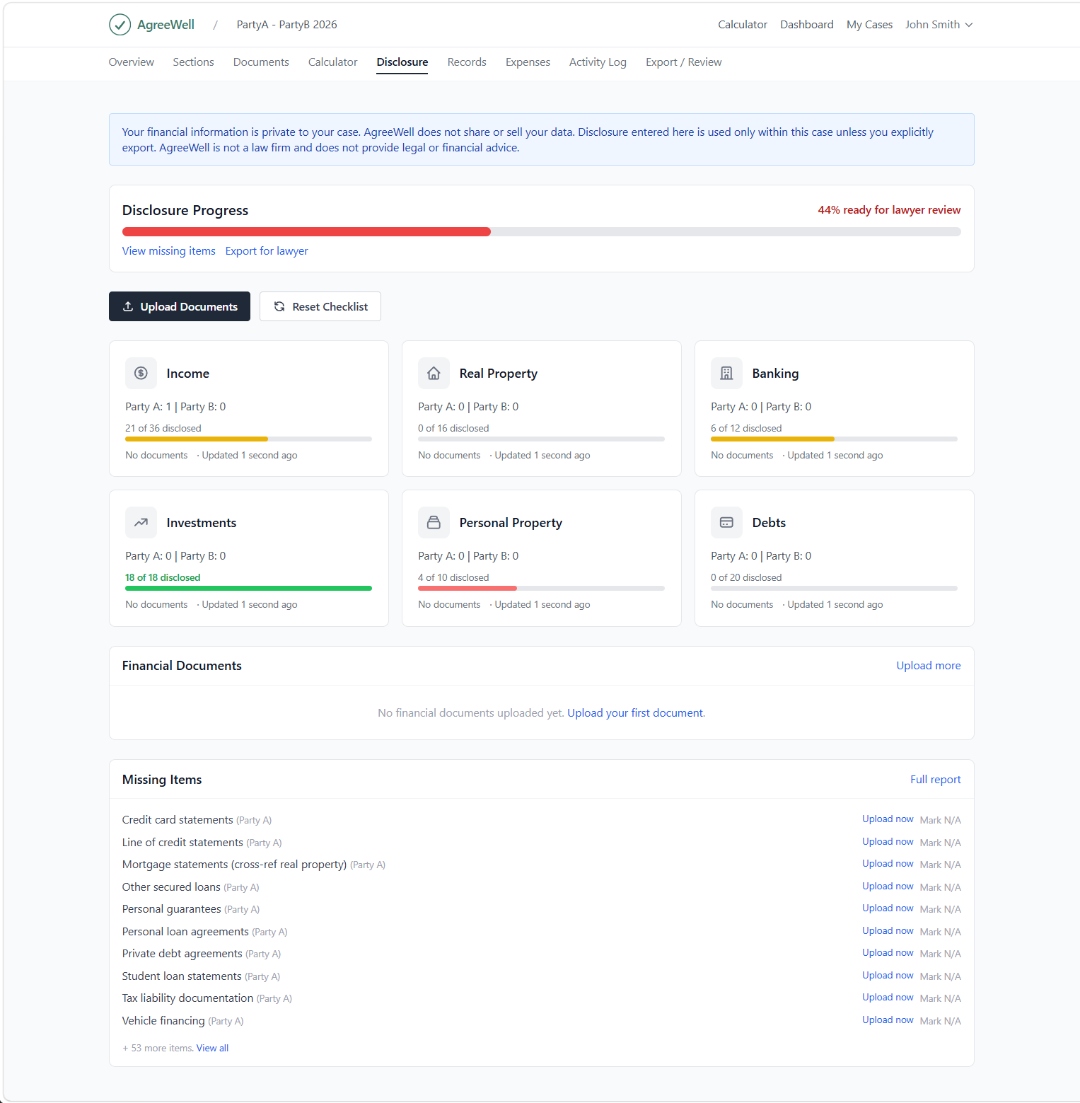
AgreeWell financial disclosure dashboard showing 44% ready for lawyer review, six category cards (Income, Real Property, Banking, Investments, Personal Property, Debts) with per-party progress bars, financial documents area, and a missing items checklist
The disclosure dashboard. At a glance: overall completeness, six categorized cards with each party’s progress, the financial documents library, and a live list of missing items with quick “Upload now” or “Mark N/A” actions — so nothing falls through the cracks before lawyer review.

Lawyer-ready exports.

When you're ready, generate a structured disclosure package — a single PDF with a clear summary and every document attached and labeled.

  • One PDF: cover summary, AI overview, and every document
  • Every attachment introduced with its own labeled cover page
  • Designed to slot into your lawyer or mediator's workflow

Disclosure export

1Cover summary & AI overviewIncluded
2Income — 8 documentsIncluded
3Banking — 5 documentsIncluded
4Property — 3 documentsIncluded
5Debts — 3 documentsIncluded
Section 5

Designed to work alongside your lawyer or mediator.

Less administrative chaos. More productive meetings.

AgreeWell is a workspace, not a substitute for legal advice. Couples arrive at meetings already organized. Mediators see structured progress instead of email threads. Lawyers get a clean, well-labeled disclosure package — instead of an unlabeled folder of PDFs.

  • Mediator and lawyer access can be granted with view-only or commenting roles.
  • Structured exports (PDF + CSV) drop straight into existing case files.
  • Clients arrive prepared — reducing time spent on document chasing.
AgreeWell is designed to support collaboration — not replace professional legal advice. We strongly recommend independent legal review before signing any separation agreement.
Section 6

Frequently asked questions.

What is financial disclosure?

Financial disclosure is the process of sharing accurate, complete information about your income, assets, debts, and expenses with your separating spouse. It's the foundation for any fair conversation about child support, spousal support, property division, or a separation agreement.

Is financial disclosure mandatory in Ontario?

In most cases, yes. Ontario family law generally requires both parties to provide complete financial disclosure before any separation agreement is signed or court order is made. Even outside court, disclosure is essential for any agreement to be considered fair and enforceable.

What happens if disclosure is incomplete?

Incomplete or inaccurate disclosure can delay your separation, make agreements harder to enforce, and in some cases lead a court to set aside an agreement entirely. It's one of the most common reasons separations get stuck or fall apart.

Do mediators require disclosure?

Yes. Mediators rely on accurate financial information to help couples reach fair agreements. Most mediators will ask for full disclosure before substantive discussions begin.

Can disclosure be updated later?

Yes. Disclosure is typically a continuous process — financial circumstances change, new statements arrive, and information is added over time. AgreeWell is designed to keep disclosure current as new documents come in.

Does AgreeWell replace a lawyer?

No. AgreeWell is a structured organization and collaboration platform — not a law firm, and it does not provide legal advice. We strongly recommend seeking independent legal advice before signing any separation agreement.

Is my information secure?

Yes. AgreeWell uses encrypted storage, role-based access, and audit logging. Documents are accessible only to case participants and any mediator or lawyer they invite.

Disclosure doesn't need to feel overwhelming.

AgreeWell helps organize the process so couples, mediators, and lawyers can work from a clearer, more structured foundation.