How It Works Features
Resources
How Separation Works in Canada Financial Disclosure in Ontario Shared Parenting Expenses Interim & Final Agreements Records & Chronology Support Calculator Guide Calculator Log In Start Your Case
Ontario · Separation Guide

Interim & final separation agreements.

Many separating couples need temporary arrangements long before a final legal agreement is completed. AgreeWell helps organize both interim and long-term agreements in a structured, collaborative workflow — section by section.

Section 1

What is an interim agreement?

An interim agreement is a temporary arrangement that two separating partners put in place while their separation is still being worked out. Think of it as a way to stabilize day-to-day life now, while bigger decisions are still being negotiated.

Interim arrangements often cover practical, everyday things such as:

Interim agreements aren’t meant to settle everything forever. They’re meant to take some of the uncertainty out of the next few weeks or months — so both partners can focus on working toward a final arrangement without scrambling on the basics.
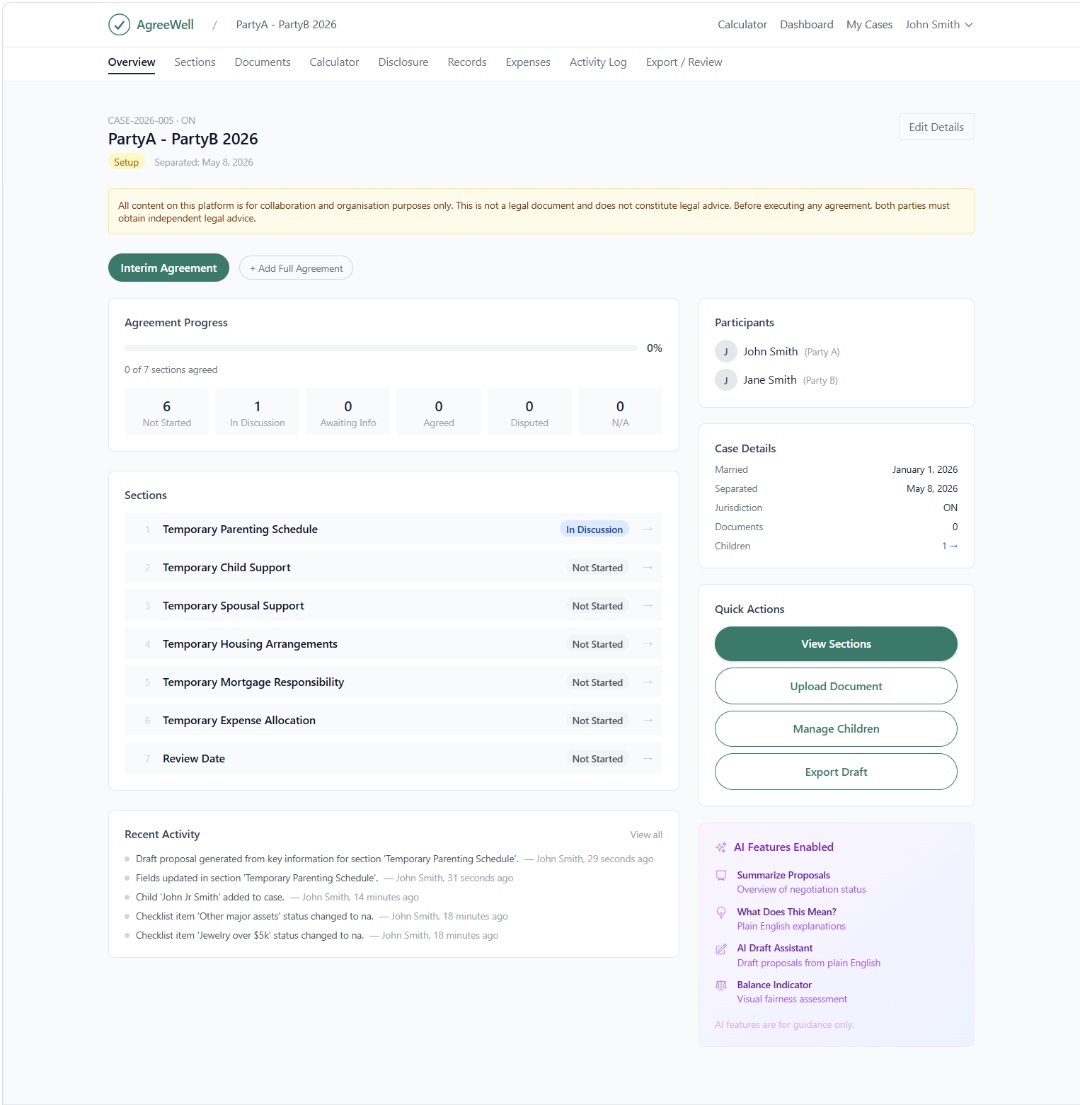
AgreeWell case overview with the Interim Agreement toggle active, showing seven temporary sections (Temporary Parenting Schedule, Temporary Child Support, Temporary Spousal Support, Temporary Housing Arrangements, Temporary Mortgage Responsibility, Temporary Expense Allocation, Review Date), agreement progress at 0 of 7 agreed, participants, case details, and quick actions
An interim agreement in AgreeWell. A focused set of temporary sections — parenting schedule, child and spousal support, housing, mortgage responsibility, expense allocation, and a review date — with progress, status counts, and a clear “this is interim” framing. Both partners see the same overview as decisions are worked through.
Section 2

Why interim agreements matter

Final separation agreements take time. Interim arrangements help families keep moving in the meantime — with structure, not improvisation.

Final agreements take months

Negotiation, disclosure, mediation, and legal review all take time. Families still need a way to handle this week and next month.

Disclosure may still be in progress

Income, asset, and debt details often take weeks to gather. Interim arrangements let life continue while disclosure is finalized.

Children need stability now

Routines, schools, and pickups can’t pause while adults negotiate. A clear interim parenting plan helps the everyday feel calmer.

Bills don’t wait

Mortgage, rent, utilities, insurance, and groceries all keep coming. Interim agreements clarify who pays what until final terms are set.

Emotions and circumstances change

What feels right at week one may shift by month three. Interim arrangements can be revisited and updated as things evolve.

Reduced uncertainty, fewer disputes

Written interim terms tend to lower friction, because both partners are working from the same understanding instead of memory.

Section 3

What is a final separation agreement?

A final separation agreement is the longer-term, documented arrangement that both partners eventually sign — usually with independent legal advice on each side. It sets out how the relationship is being unwound, what support (if any) will be paid, how property is divided, and how parenting will work going forward.

Final agreements typically cover topics such as:

Interim agreements often evolve into final agreements over time. The interim version stabilizes the present; the final version reflects the long-term decisions reached after disclosure, negotiation, and legal review.

AgreeWell is not a law firm and does not provide legal advice. We strongly recommend each partner obtain independent legal advice before signing a final separation agreement.

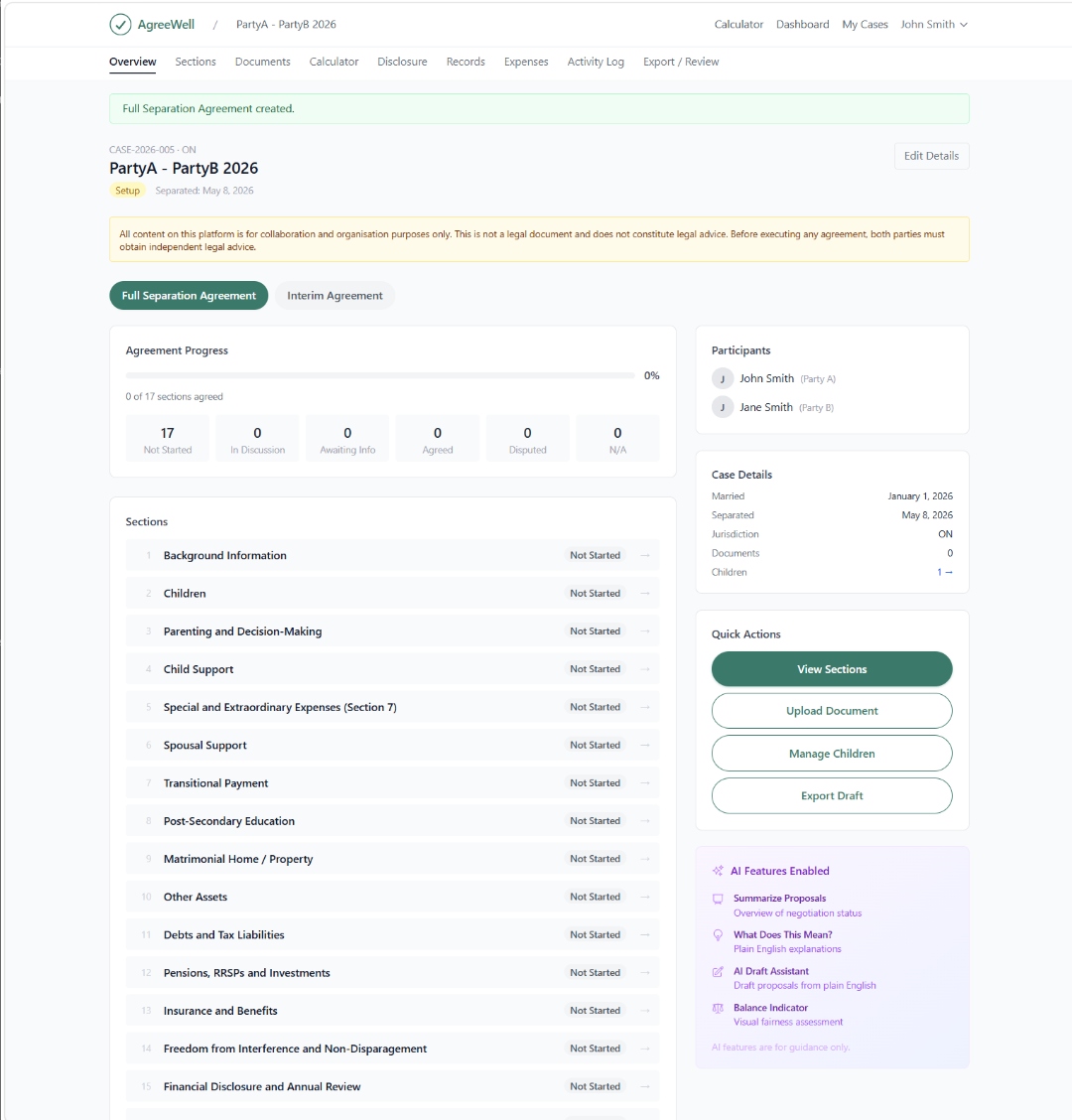
AgreeWell case overview with the Full Separation Agreement toggle active, showing seventeen sections including Background Information, Children, Parenting and Decision-Making, Child Support, Special and Extraordinary Expenses (Section 7), Spousal Support, Transitional Payment, Post-Secondary Education, Matrimonial Home / Property, Other Assets, Debts and Tax Liabilities, Pensions RRSPs and Investments, Insurance and Benefits, Freedom from Interference and Non-Disparagement, and Financial Disclosure and Annual Review
A full separation agreement. The same case can carry a more comprehensive set of sections covering parenting, support, property, debts, pensions, the matrimonial home, and ongoing review. Sections progress independently, so partners can finalize the parts they agree on while continuing to discuss the rest.
Section 4

How AgreeWell organizes agreements

AgreeWell breaks a separation agreement into clearly labelled sections — each one with its own status, proposed terms, comments, and history.

Section-by-section structure

Instead of one long document, your agreement is broken into focused sections — parenting, child support, spousal support, property, debts, and more. Each one can be worked on independently and can carry its own status: not started, in discussion, or agreed.

Sections can be marked as interim or final, so it’s clear which parts are temporary and which are intended to stick.

Collaborative proposal tracking

Either partner can draft a proposal for any section. The other partner reviews it and either agrees, suggests a change, or asks a question — all directly on the section. The full back-and-forth is preserved with timestamps.

This keeps decisions out of long text threads and email chains, and gives mediators and lawyers a clean record to review later.

Linked to disclosure, expenses, and support math

Each section can pull in the data already in your case — financial disclosure, shared expense history, and support calculator results — so proposals are grounded in real numbers, not guesses.

When you’re ready, AgreeWell exports a structured PDF summary of every section: agreed terms, open items, and supporting context — ready for review with a mediator or lawyer.

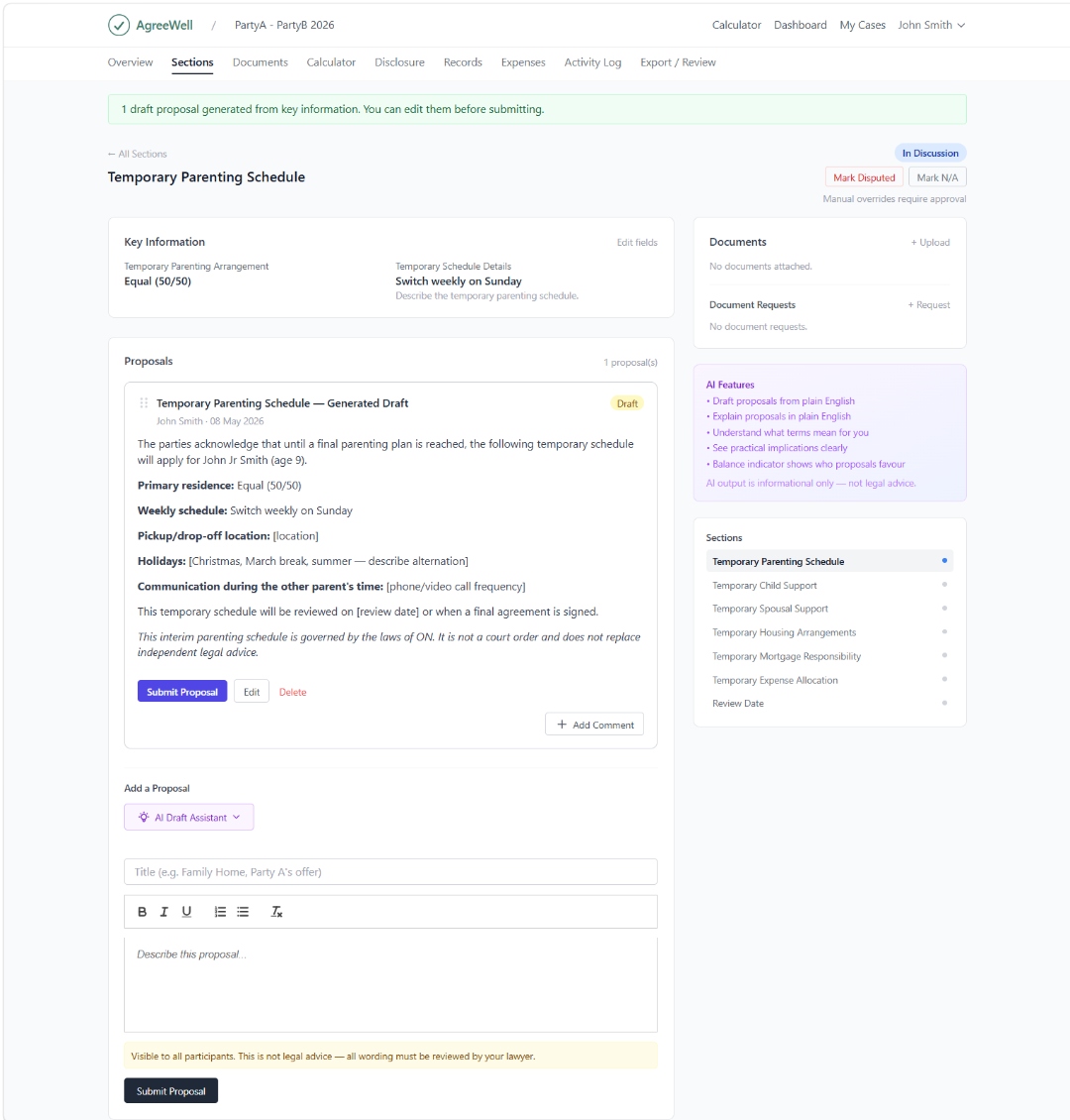
AgreeWell section detail page for Temporary Parenting Schedule, showing key information (arrangement and schedule), a generated draft proposal with primary residence, weekly schedule, pickup location, holidays, and communication, status chips for Mark Disputed and Mark N/A, an AI Draft Assistant control, a proposal editor, attached documents and document requests, and a section list down the right side
Inside a section. Each section has its own key information, proposals, comments, and status. Either partner can draft a proposal in plain English (optionally with AI assistance), edit before submitting, and discuss in context — with disclaimers reminding everyone that the wording must be reviewed by independent qualified lawyers before anything is signed.
Section 5

A clear agreement workflow

A predictable path from "we’ve decided to separate" to "we have a structured, lawyer-ready summary of what we’ve agreed."

  1. 1

    Create your case

    Both partners are added to a shared case. Roles, party names, and basic case details are captured up front.

  2. 2

    Organize disclosure

    Income, assets, debts, and supporting documents are uploaded and organized — so any agreement is grounded in real numbers.

  3. 3

    Build interim arrangements

    Set temporary terms for parenting, support, housing, and bills while final decisions are still being worked out.

  4. 4

    Discuss proposals collaboratively

    Each section becomes a focused conversation: propose, review, comment, and adjust — without losing the thread.

  5. 5

    Track agreed and disputed sections

    Every section carries a clear status. You always know what’s agreed, what’s open, and what still needs disclosure.

  6. 6

    Prepare lawyer-ready summaries

    Export a structured PDF of the case — agreed terms, supporting disclosure, and outstanding items — ready to walk into a mediation or legal review.

  7. 7

    Final review & signing

    Each partner’s lawyer reviews and finalizes the agreement. AgreeWell’s job is to make that step as efficient as possible.

Section 6

Designed to work alongside mediators & lawyers

AgreeWell is built to support the work mediators and lawyers do — not replace it. The platform handles the operational, organizational side of getting to an agreement: structure, history, and clean records.

  • Agreement sections with clear, current status
  • A complete history of proposals, comments, and decisions
  • Linked financial disclosure for context
  • Support calculator results for transparent math
  • Structured PDF exports for review meetings
  • Reduced administrative overhead and prep time

AgreeWell is designed to support collaboration and preparation — not to replace professional legal advice. We strongly recommend each partner obtain independent legal review before signing a final separation agreement.

Section 7

Frequently asked questions

What is an interim separation agreement?

An interim separation agreement is a temporary arrangement that two partners put in place while their separation is still being negotiated. It usually covers parenting schedules, temporary support, who pays which bills, and how the family home is being used in the meantime. It’s designed to stabilize day-to-day life until a final agreement is reached.

Are interim agreements legally binding?

Whether an interim agreement is legally binding depends on how it’s structured, signed, and the laws in your province. Some interim arrangements are informal understandings between partners; others are signed contracts with independent legal advice on each side. AgreeWell does not provide legal advice. If you need certainty about enforceability, we strongly recommend reviewing your interim arrangement with a family lawyer in your jurisdiction.

Why do couples use temporary agreements?

Final separation agreements often take months to complete — disclosure, negotiation, mediation, and legal review all take time. Families still need to handle parenting, bills, and housing in the meantime. Temporary agreements give both partners a clear, written understanding of how those things will work until a final agreement is in place.

What is included in a separation agreement?

A typical final separation agreement covers parenting (schedule and decision-making), child support, section 7 expenses, spousal support if applicable, division of property and debts, treatment of pensions and the matrimonial home, and confirmation that financial disclosure has been exchanged. The exact contents vary by family and by what each partner’s lawyer recommends.

Can agreements change over time?

Yes. Interim arrangements are expected to change as more information becomes available and as circumstances evolve. Final agreements can also be updated — usually through a written amendment signed by both partners with independent legal advice. AgreeWell tracks the full history of every section, so you always know what was agreed and when.

Does AgreeWell replace a lawyer?

No. AgreeWell is not a law firm and does not provide legal advice. The platform helps families organize the operational side of separation — disclosure, expenses, proposals, and agreement sections — so lawyers and mediators can focus on the higher-value work of advising and finalizing the agreement.

Can mediators use AgreeWell with clients?

Yes. Mediators often work with families who have used AgreeWell to organize disclosure and draft proposals before sessions. Structured records make mediation time more productive, because the conversation can focus on decisions instead of reconstructing what’s already happened. If you’re a mediator interested in using AgreeWell with your practice, please reach out at support@agreewell.ca.

Move from improvising to agreement.

Separation agreements often evolve over time. AgreeWell helps families organize interim and long-term arrangements in a more structured and collaborative way — so the next conversation, the next mediation, and the final review are all easier.